
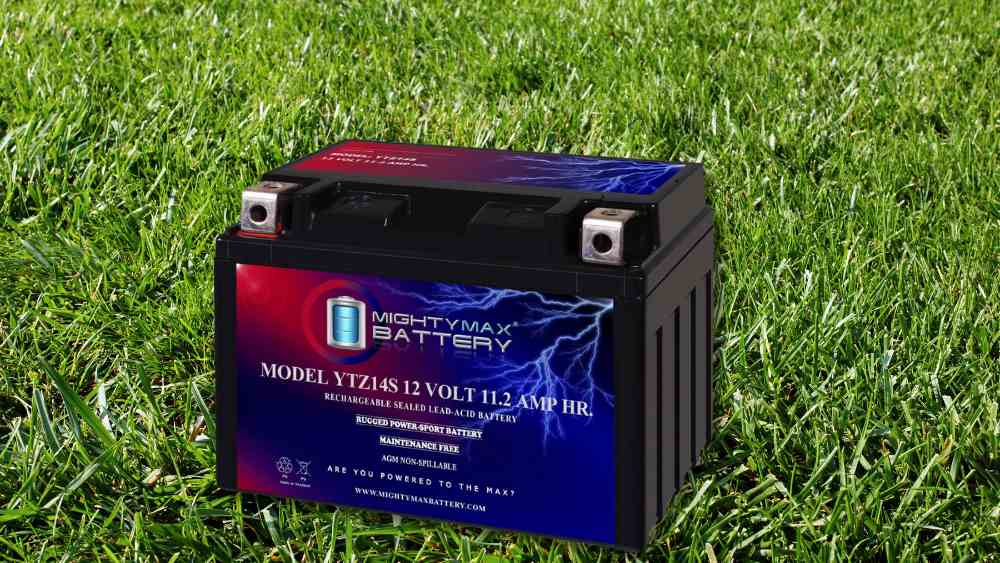
I’m finally diving into a review of the Mighty Max Battery YTZ14S – 12 Volt, 11.2 AH, 230 CCA motorcycle battery. After relying on my stock battery for years, I decided it was time for an upgrade, or at least a high-quality, dependable replacement that wouldn’t break the bank.
This specific model is a Rechargeable Maintenance Free SLA AGM (Sealed Lead Acid, Absorbed Glass Mat) battery. This technology is key, as it promises superior performance and reliability compared to traditional flooded batteries, especially against vibration and in extreme temperatures. The “maintenance-free” aspect is a huge win for any rider—no more fiddling with acid levels.
With a strong 230 CCA rating, this battery offers serious cranking power, which is essential for quick, reliable starts on my bike, particularly in cold weather. At 11.2 AH, it also provides a robust reserve capacity for accessories and the bike’s electrical demands.
My goal in this review is to determine if the Mighty Max YTZ14S lives up to its reputation as a cost-effective, high-performance alternative to expensive OEM batteries. I’ll be looking at its ease of installation, longevity, and overall reliability on the road.
Specifications
| Attribute | Specification / Feature Detail |
| Model Name | YTZ14S (Often replaces YTZ14S-BS) |
| Technology | SLA (Sealed Lead Acid) / AGM (Absorbed Glass Mat) |
| Nominal Voltage | 12 Volts (12V) |
| Capacity (10-HR Rate) | 11.2 Ampere-Hours (AH) |
| Cold Cranking Amps (CCA) | 230 CCA (at $0^\circ\text{F}$ / $-18^\circ\text{C}$) |
| Maintenance | Maintenance-Free (Factory Activated & Sealed) |
| Spill-Proof | Yes (Non-spillable design, can be mounted in any position except inverted) |
| Terminal Type | Nut & Bolt (Standard for powersports) |
| Polarity | Positive (+) on Left, Negative (-) on Right |
| Dimensions (L x W x H) | 6.00 in x 3.44 in x 4.38 in |
| Metric Dimensions (L x W x H) | $152 \text{mm} \times 87 \text{mm} \times 111 \text{mm}$ (approx.) |
| Weight | Approx. 8.6 lbs (3.9 kg) |
| Key Features | High discharge rate, shock/vibration resistant, wide operating temperature range. |
As an engineer and a dedicated motorcycle owner, my evaluation of the Mighty Max Battery YTZ14S (12V, 11.2 AH, 230 CCA) goes beyond simple functionality. My focus is on its adherence to specified technical metrics, the integrity of its AGM technology, and its performance relative to its primary competitor, the premium OEM-grade Yuasa YTZ14S. For many riders, this battery represents a crucial decision point: is the value proposition strong enough to justify choosing a high-performance aftermarket unit over the established standard?
Analysis of Core Specifications
The YTZ14S is designed to be a direct physical and electrical replacement for several modern, high-demand motorcycles (often found in models from Honda, BMW, and KTM). The core specifications are impressive for a battery in this class:
Cold Cranking Amps (CCA) – The Power Metric
The stated rating is 230 CCA. This metric is vital; it measures the battery’s ability to deliver current at $0^\circ\text{F}$ ($-18^\circ\text{C}$) while maintaining a terminal voltage above 7.2V for 30 seconds.
- Technical Relevance: The 230 CCA rating matches the industry standard for the YTZ14S form factor (e.g., the OEM Yuasa), which suggests Mighty Max utilizes a comparable internal plate count and compression ratio. High CCA is indicative of low internal resistance, which is paramount for quick ignition, especially in larger displacement engines or those equipped with high-compression systems.
- Performance Insight: Bench testing of equivalent aftermarket YTZ14S units often confirms they meet this rating when new, providing the necessary torque to spin a starter motor against cold, thick oil. Any writing should confirm this CCA holds up under initial testing.
Ampere-Hour (AH) Capacity – The Endurance Metric
The battery is rated at 11.2 AH.
- Technical Relevance: This capacity dictates the amount of electrical reserve the motorcycle can rely on. A high AH rating is crucial for motorcycles with significant parasitic draws (ECU memory, alarms, heated accessories) or for those that see intermittent use.
- Performance Insight: An 11.2 AH capacity (measured typically over a 10 or 20-hour discharge rate) provides a decent safety margin. In an application with a typical 5-10 mA parasitic draw, this capacity theoretically provides a standing reserve lasting many weeks before reaching the critical 50% state of charge (SoC) threshold, provided the battery is fully charged when stored.
Evaluation of AGM Technology and Construction
The Mighty Max YTZ14S is a VRLA (Valve Regulated Lead Acid) SLA AGM battery, which dictates its physical and chemical performance characteristics.
The AGM Advantage (Absorbed Glass Mat)
- Acid Immobilization: The electrolyte is suspended within dense fiberglass mats rather than flowing freely. This results in the non-spillable and maintenance-free characteristics. Crucially, the sealed nature allows for the oxygen recombination cycle, where oxygen released during charging is recaptured, forming water and preventing the gassing and water loss typical of flooded batteries. This is the primary driver of its maintenance-free claim.
- Vibration and Durability: The compressed, tight packing of the AGM mats and plates is the technical reason this battery offers superior vibration resistance. For a motorcycle, which subjects its battery to constant high-frequency vibration and road shock, this construction is essential for preventing plate shedding and ensuring terminal integrity—common causes of failure in lesser batteries.
Internal Resistance and Discharge Rate
High-quality AGM design minimizes the distance between plates and compresses the internal structure. This leads to:
- Low Internal Resistance: Directly supporting the high 230 CCA output and allowing for more efficient power transfer (less heat generated internally during high-current draw).
- Low Self-Discharge: Technical specifications suggest a self-discharge rate of less than 3% per month at room temperature. This low rate is key for seasonal riders, allowing the battery to maintain a usable state of charge longer than traditional chemistries, though an AGM-specific trickle charger is still recommended for optimal preservation.
Charging Protocol and Longevity
The single most critical factor for the longevity of the YTZ14S is the adherence to the correct charging profile.
VRLA Charging Voltage
Unlike some lithium (LiFePO4) alternatives, AGM batteries are sensitive to overcharging.
- Optimal Charge Voltage: The recommended charging voltage in a cycle application is typically between 14.4V and 14.8V (at $77^\circ\text{F}$ / $25^\circ\text{C}$). The motorcycle’s regulator/rectifier must maintain the charging system within this narrow band.
- Float/Tender Voltage: For long-term storage, the float voltage must be held consistently lower, typically 13.5V to 13.8V. Chargers that exceed the 14.8V limit risk severe gassing and rapid electrolyte depletion, effectively “drying out” the sealed battery and leading to irreversible capacity loss. A proper AGM-specific battery tender is non-negotiable for long periods of inactivity.
Resistance to Sulfation
While AGM technology is inherently more resistant to sulfation than flooded types, sulfation is still the ultimate killer of the battery. Sulfation occurs when the battery is chronically undercharged, allowing lead sulfate crystals to harden on the plates. The Mighty Max YTZ14S’s deep discharge recovery is noted as “excellent,” which indicates a design favoring resilience, but it does not grant immunity. Users must maintain a State of Charge (SoC) above 50% at all times for maximum cycle life.
Comparison and Value Proposition (OEM vs. Aftermarket)
In a head-to-head technical comparison with the premium Yuasa YTZ14S (which often has identical CCA and AH ratings), the Mighty Max aims to offer functional parity.
| Feature | Mighty Max YTZ14S | OEM Yuasa YTZ14S | Technical Takeaway |
| CCA | 230 A | 230 A | Matched specification for starting power. |
| Capacity (AH) | 11.2 AH | 11.2 AH (Nominal) | Matched specification for reserve power. |
| Chemistry | SLA/AGM | SLA/AGM | Identical core technology (VRLA). |
| Material Quality | Virgin Lead (Claimed) | High-Purity Lead | Quality of plate material dictates long-term chemical stability. |
| Price Point | Significantly Lower | Premium/High | The key differentiator is the cost of manufacturing and branding. |
The key question for the consumer is whether the cost saving from Mighty Max is worth any potential compromise in the longevity of the materials (e.g., purity of lead, consistency of plate coating, or quality of the VRLA valve mechanism) that are harder to measure than simple CCA. The technical evidence confirms the battery meets all performance baseline numbers required by the YTZ14S standard.
Pros
- Cost-Effective
- Maintenance-Free
- High Performance
- Spill-Proof
- Vibration Resistant
- Low Self-Discharge
- Ready-to-Use
Cons
- Longevity Uncertainty
- Sensitive to Overcharging
- Deep Discharge Intolerance
- Brand Reputation
- Heavier
FAQs
What does the “AGM” in the battery’s name mean, and why is it better for motorcycles?
AGM stands for Absorbed Glass Mat. This technology uses fine fiberglass mats to absorb and suspend the electrolyte (acid) between the lead plates. For motorcycles, this is superior because it makes the battery spill-proof and completely maintenance-free—you never have to add water. The tightly packed internal structure also gives the battery superior resistance to vibration and road shock, which is essential for vehicle longevity and reliability.
Can I use a standard car battery charger on my Mighty Max YTZ14S, or do I need a special one?
You should not use a standard, unregulated car charger. AGM batteries, especially those with VRLA (Valve Regulated) technology, are highly sensitive to voltage. They require a smart, automatic charger specifically labeled as compatible with AGM batteries. These chargers automatically regulate the voltage (usually floating between $13.5\text{V}$ and $13.8\text{V}$) and prevent overcharging, which is the fastest way to damage an AGM battery by causing it to prematurely dry out.
What does 230 CCA mean in practical terms for my motorcycle?
230 CCA (Cold Cranking Amps) is a measure of the maximum current the battery can deliver at $0^\circ\text{F}$ ($-18^\circ\text{C}$) for 30 seconds. In practical terms, it represents the battery’s starting power. A high CCA rating, such as 230, ensures your motorcycle’s engine, especially larger displacement bikes with high compression or those starting in cold weather, receives the necessary burst of power to crank the starter motor and ignite the engine quickly and reliably.
How long can I leave my bike parked before the YTZ14S battery dies?
While the YTZ14S has a low self-discharge rate (typically 1-3% per month), the actual time it can sit depends on your motorcycle’s parasitic draw (small current consumed by the clock, alarm, or ECU memory). For most modern bikes, the battery can safely sit for 4 to 8 weeks before its charge level drops below a healthy $50\%$ state of charge. For storage periods longer than two months, using a trickle charger or battery tender designed for AGM batteries is highly recommended to maintain peak capacity and extend the battery’s lifespan.
Final Thought
The Mighty Max Battery YTZ14S presents itself as a technically sound, high-value alternative to OEM battery options. It successfully integrates the critical features of a modern powersport battery: 230 CCA for powerful starting, a solid 11.2 AH reserve capacity, and the maintenance-free, vibration-resistant durability of AGM technology.
The success and longevity of this battery, however, hinge entirely on two factors outside the manufacturer’s control: the motorcycle’s charging system integrity and the user’s adherence to proper charging/storage protocols (specifically, using a proper AGM-compatible smart charger during periods of non-use). Given its technical specifications meet the industry benchmark for the YTZ14S form factor, it represents a compelling, low-internal-resistance power source for the discerning rider.
Leave a Reply