
As an owner of a small powersport vehicle—be it an ATV, a scooter, or a dirt bike—I know the sinking feeling of hitting the starter button only to be met with a pathetic click. Finding a reliable and affordable replacement battery can be a major headache, especially when OEM prices are through the roof.
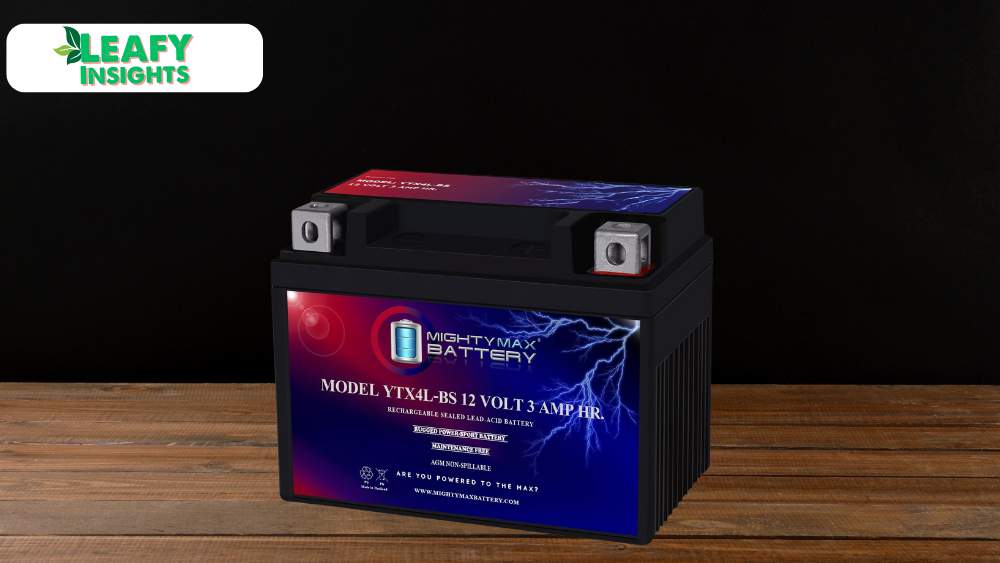
That’s why I’m dedicating this introduction to the Mighty Max Battery YTX4L-BS—a 12 Volt, 3 Amp Hour (AH) unit with a 50 Cold Cranking Amps (CCA) rating. This model stands out as the go-to value option in the small engine market. It utilizes Sealed Lead Acid (SLA) Absorbed Glass Mat (AGM) technology, meaning it arrives factory-sealed, spill-proof, and entirely maintenance-free. You simply install it and go, making it a dream for weekend warriors and daily commuters alike. My goal is to break down why this specific $20-$25 battery is often the most practical choice, offering an exact fit, reliable power, and AGM durability without the unnecessary premium price tag. Let’s see if this powerhouse lives up to its reputation as the “best bang for your buck.

Specifications
| Feature Category | Attribute | Value | Details / Significance |
| Model & Technology | Model Name | YTX4L-BS | Industry-standard size/rating. |
| Battery Type | Sealed Lead Acid (SLA) | Maintenance-free design. | |
| Technology | Absorbed Glass Mat (AGM) | Spill-proof, vibration-resistant, low self-discharge. | |
| Electrical Ratings | Voltage | 12 Volts (12V) | Standard powersport voltage. |
| Capacity | 3 Ampere-hours (3 AH) | Measured at the 10-hour rate. | |
| Cold Cranking Amps (CCA) | 50 CCA | Starting power for small displacement engines ($50\text{cc}$ to $125\text{cc}$). | |
| Self-Discharge Rate | $1-3\%$ per month | Low rate, contributing to good shelf life. | |
| Physical Dimensions | Length (L) | $4.40 \text{ inches}$ ($114 \text{mm}$) | Critical for fitment in small battery boxes. |
| Width (W) | $2.90 \text{ inches}$ ($71 \text{mm}$) | ||
| Height (H) | $3.42 \text{ inches}$ ($86 \text{mm}$) | ||
| Weight | $\approx 3.1 \text{ lbs}$ ($\approx 1.4 \text{ kg}$) | Lightweight design for small vehicles. | |
| Terminal & Polarity | Terminal Type | Nut & Bolt / Bolt Terminal | Standard for powersport applications. |
| Polarity | Negative on Left, Positive on Right | When viewed from the front (terminals facing you). | |
| Charging | Standard Charge Current | $0.3 \text{A}$ to $0.4 \text{A}$ | $10\%$ of AH capacity, recommended for max life. |
| Max Charge Voltage (Cyclic) | $14.4 \text{V}$ to $14.8 \text{V}$ | ||
| Float Charge Voltage (Storage) | $13.5 \text{V}$ to $13.8 \text{V}$ | Ideal for connection to a battery maintainer. |
As an avid owner and maintainer of small-displacement powersport vehicles—ranging from scooters to youth ATVs and lightweight enduro bikes—I’ve encountered the inevitable battery replacement decision countless times. The Mighty Max Battery YTX4L-BS stands out immediately for its position in the market: it provides an industry-standard specification using modern battery technology at a price point that aggressively undercuts OEM and premium brands. This review focuses specifically on the technical merits and practical user experience of this Sealed Lead Acid (SLA), Absorbed Glass Mat (AGM) battery, evaluating whether its performance justifies its budget-friendly cost.
The fundamental appeal is clear: it’s a direct, drop-in replacement for any vehicle calling for the YTX4L-BS form factor, promising a maintenance-free life. But does it deliver the necessary $50 \text{ CCA}$ reliably, and how well does its $3 \text{ AH}$ capacity hold up under real-world conditions?
Fitment Analysis
The YTX4L-BS designation is a crucial starting point. In the powersport world, fitment is non-negotiable due to the extremely tight tolerances of battery compartments. The Mighty Max adheres perfectly to the required physical dimensions: $4.40 \text{ in (L)} \times 2.90 \text{ in (W)} \times 3.42 \text{ in (H)}$. This dimensional accuracy is vital; even a minor deviation could prevent the battery box cover from latching or compromise the mounting strap, leading to dangerous rattling and potential premature cell damage.
Electrical Ratings Breakdown
| Attribute | Value | Technical Context |
| Voltage | $12 \text{V}$ | Standard for all small engine starting batteries. |
| Capacity (AH) | $3 \text{ AH}$ (10-HR Rate) | Extremely low reserve power; limits reliance on engine-off accessories. |
| CCA | $50 \text{ CCA}$ | Sufficient for low-compression engines ($\approx 50\text{cc} – 125\text{cc}$). |
| Polarity | Negative on Left / Positive on Right | Standardized terminal layout crucial for cable attachment. |
Capacity (3 AH): The low $3 \text{ AH}$ capacity is the first indicator of the battery’s intended use. It is engineered purely as a starter battery, not a deep-cycle or accessory power source. Running the vehicle’s headlights or simple accessories (like a GPS or phone charger) for more than $30 \text{ minutes}$ with the engine off is a guaranteed path to severe discharge and potential sulfation. This necessity reinforces the need for a vigilant charging routine, especially during the off-season.

Cold Cranking Amps (50 CCA): $50 \text{ CCA}$—the power delivered at $0^\circ\text{F}$ ($-18^\circ\text{C}$)—is adequate for the small engines it serves. In temperate conditions, the starting performance is excellent and snappy. However, this small reserve is a liability in extreme cold. While the AGM technology minimizes internal resistance, the laws of physics dictate a steep drop-off in chemical efficiency below freezing. For users in northern climates, this battery requires a pre-emptive charge regimen during winter storage to ensure reliable spring startup.
AGM Technology: Practical Advantages
The decision to use Absorbed Glass Mat (AGM) technology over traditional flooded lead-acid is the battery’s core technical strength, especially given its price.
Maintenance-Free and Safety
As an SLA, this battery is factory-activated and permanently sealed. This eliminates the need to check water levels or add acid, a cumbersome task often overlooked by casual riders. More critically, the sealed, non-spillable design offers superior safety. The electrolyte is absorbed into the glass mats, preventing acid leakage even if the case is breached or the battery is installed at a non-standard angle. This feature is particularly valuable in ATVs and dirt bikes that experience frequent jolts and extreme tilts.
Vibration Resistance
Motorcycles and ATVs are vibration environments. The internal compression created by the tightly packed AGM separators is designed to immobilize the lead plates. This mechanical stability prevents plate shedding and cracking—the two primary causes of failure in high-vibration applications. In comparison, a conventional flooded battery often succumbs quickly to these mechanical stresses.
Low Self-Discharge
AGM batteries typically exhibit a low self-discharge rate—around $1\%$ to $3\%$ per month when disconnected and stored cool. This is a significant advantage over flooded cells and means the Mighty Max can tolerate longer periods of non-use without suffering damaging deep discharge, provided it is fully charged before storage.
User Maintenance and Charging Protocol
The “maintenance-free” label applies only to electrolyte management; the battery still requires electrical maintenance to achieve its full potential lifespan (estimated at 3-5 years).
Proper Charging Voltage
The longevity of the Mighty Max is directly tied to the user’s charging habits. Overcharging is the primary killer of AGM batteries. The correct charging protocol demands a voltage-regulated charger (a “smart charger”) designed specifically for AGM/SLA types.
- Float/Storage Voltage: $13.5 \text{V}$ to $13.8 \text{V}$
- Charging Current: Must not exceed $10\%$ of the AH rating. For this $3 \text{ AH}$ unit, the optimal current is $\mathbf{0.3 \text{A}}$ to $\mathbf{0.4 \text{A}}$. Using a high-amp automotive charger will rapidly destroy the battery by causing excessive gassing, heat, and internal drying (thermal runaway).
Vehicle Charging System Check
Upon installation, a technical user must verify the vehicle’s charging system. A new battery failing within months is often not the battery’s fault but a symptom of a faulty voltage regulator or stator. The running voltage measured across the Mighty Max terminals at moderate RPM should be stable between $13.8 \text{V}$ and $14.8 \text{V}$. Any reading outside this range indicates a systemic problem that must be resolved to protect the new unit.

Market Comparison and Value Assessment
The Mighty Max YTX4L-BS competes squarely on price. While premium brands like Yuasa offer similar AGM technology, they typically carry a cost premium of $100\%$ to $200\%$.
The single most compelling reason to choose Mighty Max is the price-to-specification ratio. It offers the non-spillable, vibration-resistant, maintenance-free benefits of AGM—essential features for powersport—at a fraction of the cost.
- Competitive Disadvantage: The only technical area where it realistically falls short is ultimate cycle life compared to the most expensive premium AGMs or high-end Lithium-Ion (LiFePO4) alternatives. While Lithium offers a massive jump in weight savings and cycle life (often 10+ years), its cost (up to 4x-6x the Mighty Max price) is prohibitive for many riders.
The Mighty Max YTX4L-BS is, therefore, the intelligent middle ground: superior to conventional flooded batteries and significantly cheaper than the high-performance tier.

Its performance is reliable, provided the user respects its low capacity and adheres to correct charging protocols (low-amperage smart chargers). It is not a battery designed for sustained accessory use or extreme northern winters without maintenance. However, for a user seeking a budget-conscious, high-quality replacement that adheres to all critical OEM specifications and offers the modern benefits of maintenance-free AGM technology, the Mighty Max YTX4L-BS is a highly recommended and technically sound choice.
| Category | Pros (Advantages) | Cons (Disadvantages) |
| Value & Price | ✅ Highly Affordable: Significantly cheaper than OEM/premium brands. | ❌ Potential Longevity Risk: Some reports of shorter lifespan vs. premium brands. |
| Technology | ✅ Maintenance-Free (SLA): No need to check or add water/acid. | ❌ Sensitivity to Charging: Can be easily damaged by high-amperage, unregulated chargers. |
| ✅ Vibration Resistance (AGM): Durable against road shocks and engine vibration. | ❌ High Recycling Requirement: Contains lead and acid; must be recycled properly. | |
| Performance | ✅ Spill-Proof/Safety: Can be mounted at various angles without leakage. | ❌ Low Reserve Capacity (3 AH): Drains quickly if accessories are left on. |
| ✅ Ready to Use: Factory-activated and charged for immediate installation. | ❌ Limited Cold Performance (50 CCA): May struggle in extreme freezing temperatures. | |
| Fitment | ✅ Exact Fitment: Perfect dimensional match for the YTX4L-BS standard. |
Why should choose Mighty Max YTX4L-BS
You should choose the Mighty Max YTX4L-BS because it offers the best balance of modern AGM technology and cost-effectiveness in the small powersport battery market. This product provides all the critical benefits of premium batteries—it’s maintenance-free, spill-proof, and highly resistant to vibration—all necessary features for demanding motorcycle and ATV applications. By adhering precisely to the YTX4L-BS specifications (12V, 3 AH, 50 CCA), it ensures a perfect drop-in fit for numerous small engines. Ultimately, the Mighty Max allows you to secure a reliable, durable AGM starter battery that is ready to use right out of the box, without paying the significant price premium associated with major OEM or competitor brands.
FAQs
What is the difference between this AGM battery and a standard flooded (wet) battery?
The Mighty Max YTX4L-BS uses Absorbed Glass Mat (AGM) technology, meaning the acid is absorbed into fiberglass mats, making the battery permanently sealed, spill-proof, and entirely maintenance-free. Conventional flooded batteries require periodic topping off with distilled water and risk leaking acid, especially if tipped. AGM technology also provides superior vibration resistance and a lower self-discharge rate, making it more robust and durable for powersport vehicles.
How long will the $3 \text{ AH}$ capacity last if I leave my accessories or lights on?
The $3 \text{ Ampere-hour (AH)}$ capacity is very small and is intended only for engine starting. If you leave a typical motorcycle low-beam headlight ($3 \text{ amps}$) or other accessories on with the engine off, the battery could be completely depleted in less than one hour. It is critical to use this battery only for starting and rely on the vehicle’s alternator/stator to immediately recharge it; leaving accessories on will lead to damaging deep discharge.
What specific type of charger should I use, and what should I avoid?
You must use a Smart Charger or Battery Maintainer specifically rated for AGM batteries. It should have an output current of $1 \text{ amp}$ or less (ideally around $0.3 \text{A}$ to $0.4 \text{A}$ for this $3 \text{ AH}$ unit). Avoid high-amperage automotive chargers (5 amps or more) and old, unregulated trickle chargers, as these will supply too much current and voltage, leading to excessive heat and permanent internal damage to the AGM cells.
Can this battery be installed in any position on my vehicle?
Since the Mighty Max YTX4L-BS is sealed and uses AGM technology, it is non-spillable and generally safe to install in many positions. However, it is strongly recommended to install the battery with the terminals facing upwards or in a vertical orientation to maximize gas recombination efficiency and ensure the longest possible lifespan. Always prioritize following the vehicle manufacturer’s installation guidelines.
Final Thought
The Mighty Max YTX4L-BS is an excellent technical fit for the small powersport market. Its $50 \text{ CCA}$ and $3 \text{ AH}$ specifications perfectly match the requirements of its target vehicles, and the robust SLA AGM construction ensures good resilience against vibration and spills.
Leave a Reply