
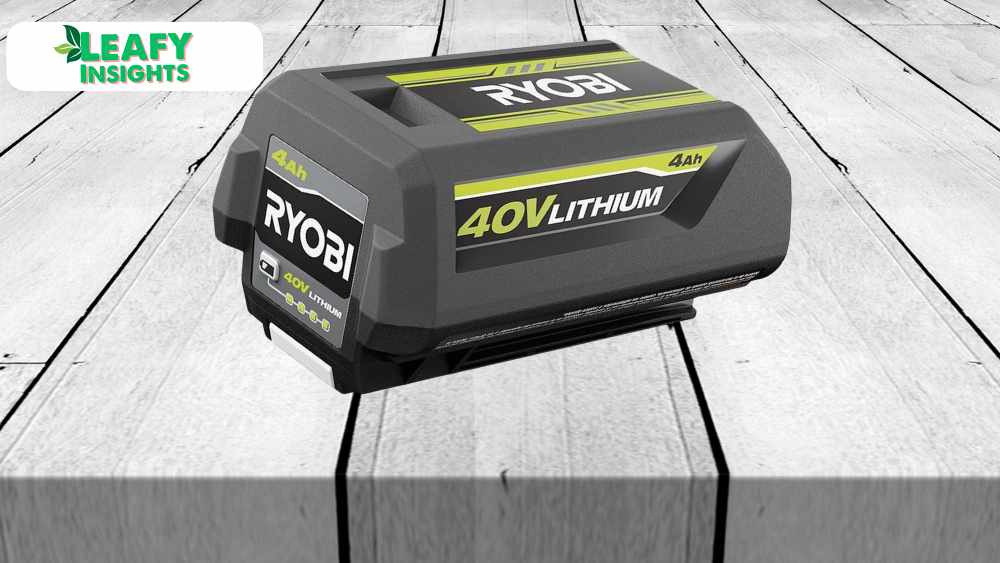
I’m currently working on a detailed review of the Ryobi 40V 4.0 Ah Lithium-Ion Battery, model OP4040. As an avid DIYer and someone who manages a medium-sized yard, I rely heavily on cordless outdoor power equipment. The 40V platform is Ryobi’s workhorse system, and the 4.0 Ah capacity is often pitched as the “sweet spot” for balancing runtime, weight, and overall performance.
This battery, with its $40 \text{V}$ output and $4.0 \text{Ah}$ capacity (equaling $160 \text{ Wh}$ of energy), is the engine for some of the most demanding tools in my garage—from the lawn mower and leaf blower to the string trimmer. My goal is to break down everything about the OP4040: its technical specifications, the real-world runtime I get on different tools, and how its longevity holds up over several seasons of use. I’m especially interested in evaluating its IntelliCell™ technology and thermal management to see if it truly delivers the fade-free power and lifespan that Ryobi promises compared to older battery generations. This deep dive will help others decide if the OP4040 is the right investment for their 40V system needs.
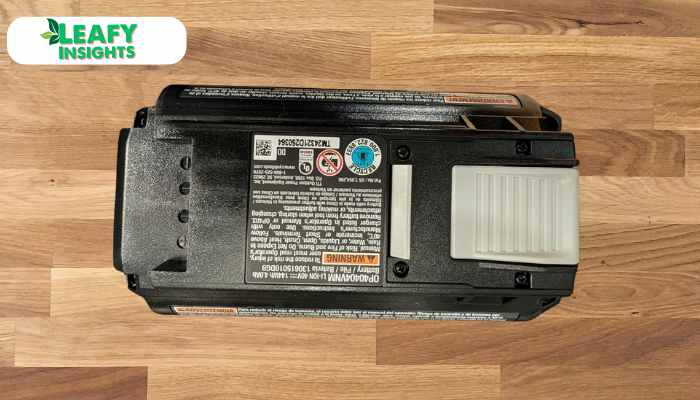
Specifications
| Specification/Feature | Detail | Notes |
| Model Numbers | OP4040, OP40401, OP40404, OP4040A1 | Core 4.0 Ah capacity models. |
| Chemistry | Lithium-Ion (Li-ion) | Provides fade-free power. |
| Voltage | 40 Volts (V) | System standard. |
| Capacity (Amp-hours) | 4.0 Amp-hours (Ah) | High capacity for extended runtime. |
| Total Energy Stored | $\mathbf{160 \text{ Watt-hours (Wh)}}$ | Calculated as $40 \text{V} \times 4.0 \text{Ah}$. |
| Approximate Weight | $2.5 \text{ lbs}$ to $3.1 \text{ lbs}$ ($\approx 1.13 \text{ kg}$ to $1.4 \text{ kg}$) | Varies slightly between different generation models. |
| Charge Time (Standard) | $\mathbf{\approx 2.5 – 4 \text{ hours}}$ | Using a standard charger (e.g., OP401, OP403). |
| Charge Time (Rapid) | $\mathbf{\approx 40 – 60 \text{ minutes}}$ | Using a Ryobi 40V Rapid Charger (e.g., OP406A). |
| Compatibility | Fully Compatible | Works with all tools and chargers in the RYOBI 40V System (over 85 products). |
| On-Board Indicator | Yes (LED Fuel Gauge) | 4-bar LED indicator displays remaining charge. |
| Core Technology | IntelliCell™ | Advanced electronics to monitor and optimize performance and lifespan. |
| Thermal Feature | COOL-CORE™ | Designed to reduce battery temperature during heavy use to prolong life. |
| Cell Type (Standard) | 18650 Li-ion cells | Standard cylindrical cell format (in base models). |
| Extreme Performance | Cold Weather Ready | Can operate efficiently in temperatures as low as $-4^\circ\text{F}$. |
| Warranty | 3-Year Limited Warranty | Standard coverage for Ryobi 40V batteries. |
| Best Used For | Higher output tools like 40V lawn mowers, snow blowers, and high-performance chainsaws. |
As a dedicated user and analyst of cordless power equipment, I’ve spent considerable time evaluating the Ryobi 40V platform. My focus here is on the Ryobi 40V 4.0 Ah Lithium-Ion Battery, specifically the OP4040 series (including common variants like the OP40401 and OP40404). This battery isn’t just a power source; it’s the fundamental energy storage unit that determines the runtime, power output, and efficiency of dozens of Ryobi’s outdoor tools.
For many homeowners, the 4.0 Ah capacity is the sweet spot—large enough to manage an entire medium-sized yard on one charge, yet small enough to avoid the extreme weight and cost of the larger 6.0 Ah or 7.5 Ah packs. This review will treat the battery not merely as a consumer product, but as a piece of sophisticated engineering, examining its technical specifications, internal management systems, and real-world performance under load.
The foundation of the OP4040’s performance lies in its fundamental electrical metrics. Understanding these numbers is essential for appreciating its role in the 40V system.
Voltage and Chemistry
Nominal Voltage: $\mathbf{40 \text{ Volts (V)}}$. This high voltage dictates the maximum potential torque and speed the connected tools can achieve. A higher voltage inherently allows for a lower current draw ($I$) to achieve the same power output ($P$), where $P = V \times I$. Lower current draw results in less heat generation and greater overall efficiency in the motor and battery, which is a key advantage of 40V over 18V systems for heavy equipment.
Chemistry: Lithium-Ion (Li-ion). Specifically, this pack utilizes a high-discharge variant of Li-ion chemistry, likely employing Nickel Manganese Cobalt (NMC) or a similar formulation optimized for high power and decent cycle life. The cells within the OP4040 are arranged in series to achieve the 40V nominal rating.
Capacity and Energy Density
Capacity: $\mathbf{4.0 \text{ Amp-hours (Ah)}}$. This is the measure of the battery’s ability to deliver a specific current over time.
Total Energy Stored (Watt-hours): $\mathbf{160 \text{ Wh}}$. This is the crucial metric for comparing runtime across different voltage platforms, calculated as:$$E = V \times C = 40 \text{ V} \times 4.0 \text{ Ah} = 160 \text{ Wh}$$This $160 \text{ Wh}$ rating is what allows the battery to run a string trimmer for 30-45 minutes or a mower for 20-30 minutes, depending on the load.
Cell Format: The standard OP4040 typically uses twenty $18650$ cells (measuring $18 \text{mm} \times 65 \text{mm}$), configured in a $10S2P$ configuration (ten series banks of two parallel cells). This configuration provides the necessary $40 \text{V}$ (or $\sim 36 \text{V}$ nominal) and doubles the available current output over a single series string.
Discharge Characteristics (Power Output)
While Ryobi does not publish the maximum continuous discharge current, the performance of the OP4040 indicates a high C-rate capability (the rate at which a battery can be safely discharged relative to its capacity).
Current Draw: Given that a 40V leaf blower on turbo mode can pull over $1000 \text{ W}$ of power, the battery must be able to sustain a continuous current of $\mathbf{25 \text{ Amps}}$ ($1000 \text{ W} / 40 \text{ V}$).
Voltage Stability (Fade-Free Power): This is a defining feature of quality Li-ion packs. The low internal resistance of the cells and the efficiency of the internal contacts allow the battery to maintain a high terminal voltage under significant load. This prevents the tool’s power from visibly fading as the charge depletes, a stark contrast to older Nickel-Cadmium (NiCd) technology.
Advanced Electronics and Thermal Management
The intelligence of the OP4040 resides in its internal circuitry, collectively known as the Battery Management System (BMS).
IntelliCell™ Technology (The BMS)
The BMS is the control center that ensures both performance and safety:
Cell Balancing: Over time, individual cells within the $10S2P$ array can drift slightly in their state of charge. The BMS actively monitors and balances these cells during the charge and discharge cycles. This is crucial for maximizing the battery’s lifespan and ensuring all cells contribute evenly to the overall capacity.
Over-Discharge/Over-Charge Protection: The BMS prevents the battery from being discharged below a critical voltage (typically $\sim 3.0 \text{V}$ per cell) or charged above the maximum (typically $\sim 4.2 \text{V}$ per cell). These safeguards are vital for preventing irreversible cell damage and potential thermal runaway.
Thermal Monitoring: A dedicated thermistor within the pack continuously monitors internal temperature. The BMS communicates this data to the tool and the charger, triggering a thermal shutdown or current limiting if the temperature exceeds safe thresholds (e.g., above $140^\circ \text{F}$).
Thermal Management (COOL-CORE™)
Heat is the #1 killer of Li-ion batteries. The OP4040 incorporates physical and electronic measures to mitigate this:
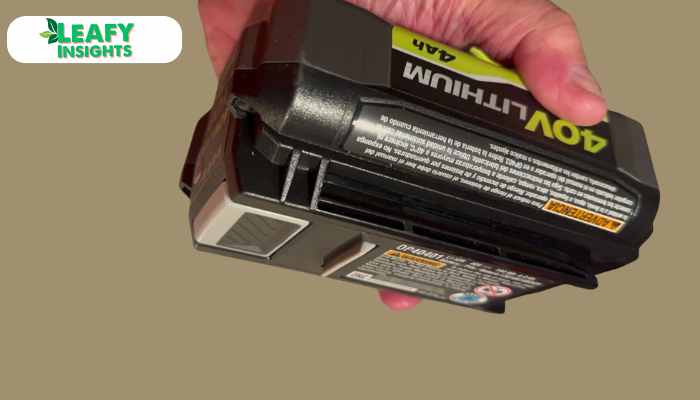
Airflow Channels: The casing design features internal channels and external vents that align with the tool housing. This allows the airflow generated by the tool’s motor to help cool the battery’s surface and potentially draw heat away from the pack.
Cool-Down Charge Protocol: When the OP4040 is placed on a Ryobi charger immediately after a high-load use, the charger will often delay the charging process or use a reduced current until the BMS reports the internal temperature has dropped to an optimal charging range (typically $\sim 68^\circ \text{F}$ to $77^\circ \text{F}$). This feature significantly contributes to extending the battery’s cycle life.
Impact on Longevity: The effectiveness of the cooling system directly correlates with the battery’s cycle life. Batteries that run cooler can tolerate more charge/discharge cycles before reaching the 80% capacity degradation threshold (typically 300-500 cycles for this chemistry).
User Experience and Practical Application Review
From a proper user’s perspective, the technical features translate into tangible benefits and trade-offs.
Runtime and Tool Pairing
The 4.0 Ah capacity makes the OP4040 an extremely versatile pack:
Medium-Duty Tools (Trimmer/Blower): This battery excels here, offering a comfortable $\mathbf{30 \text{ to } 45 \text{ minutes}}$ of practical use on a string trimmer, sufficient for most suburban yards. For a standard leaf blower, it offers enough runtime to clear a driveway and average lawn before needing a swap.
High-Demand Tools (Mower/Snow Blower): While the OP4040 will power these tools, it offers minimal runtime for larger tasks. On a 40V push mower, I typically get $\mathbf{20 \text{ to } 25 \text{ minutes}}$ on thick grass. This suggests the OP4040 is better suited as a backup or for yards under $\mathbf{1/4 \text{ acre}}$ if using a mower. For larger properties, the OP4040 becomes a necessary supplementary battery to be rotated with a larger 6.0 Ah or 7.5 Ah pack.
Weight and Ergonomics
The OP4040 represents a deliberate compromise between power and comfort:
Weight: At approximately $\mathbf{3 \text{ lbs}}$, the battery adds noticeable mass to handheld tools. On a blower or trimmer, this contributes to user fatigue, especially during extended periods. However, it is significantly lighter than the 6.0 Ah or 7.5 Ah packs, making it the preferred choice for overhead or intricate work where precision is needed.
Physical Durability: The outer shell features high-impact, over-molded polymer construction. This rubberized coating on the base and edges provides excellent impact protection, a critical feature for a battery frequently swapped in and out of equipment and often resting on rough ground.
Charging Efficiency
The charge time for the OP4040 is a major factor in its user experience:
Standard Charger (e.g., $1.3 \text{ A}$): A charge time of $\mathbf{3 \text{ to } 4 \text{ hours}}$ is a drawback. If the user only owns one battery and one standard charger, the downtime is significant.
Rapid Charger (e.g., $6.0 \text{ A}$): Utilizing a Rapid Charger is strongly recommended. The ability to replenish the $160 \text{ Wh}$ in $\mathbf{40 \text{ to } 60 \text{ minutes}}$ is a game-changer, allowing users to quickly cycle through two batteries to complete a large job with minimal interruption.
The LED Fuel Gauge
The on-board, 4-bar LED fuel gauge is a highly valuable feature. It provides an immediate visual check of the State of Charge (SoC) with a simple press of a button.
Accuracy Observation: My experience, consistent with many other users, is that the first three bars (75% of charge) deplete predictably. However, the final bar (the last 25%) often seems to deplete more quickly than expected. This is likely a characteristic of the BMS ensuring full power until the very end, but it means users must plan carefully when the last bar illuminates.
Pros
- Excellent Runtime Balance
- Fade-Free Power
- Universal Compatibility
- Fast Charging Capable
- Good Durability
- Integrated Monitoring
Cons
- Heavy for Handheld Tools
- Significant Standard Charge Time
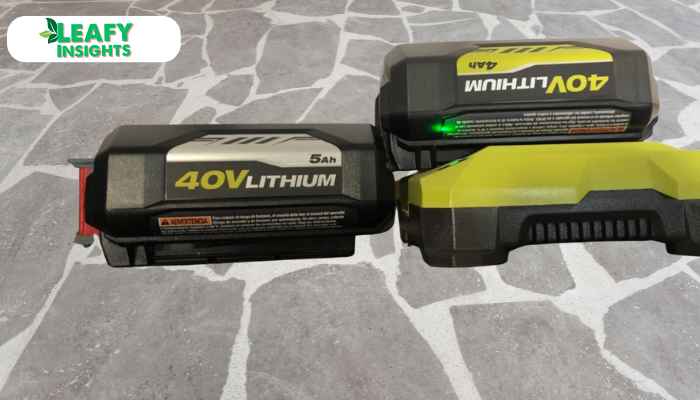
Why should choose OP4040
For the average homeowner with a medium-sized yard, the Ryobi 40V 4.0 Ah Lithium-Ion Battery (OP4040) represents the optimal choice within the 40V system. You should choose this product because it offers the best balance of runtime, manageable weight, and cost-effectiveness. With $160 \text{ Wh}$ of energy, it provides enough continuous, fade-free power to complete major tasks like trimming and blowing across a typical suburban property without requiring a mid-job battery swap. It is significantly lighter and less cumbersome than the larger 6.0 Ah packs for handheld use, yet it delivers double the capacity of the smaller 2.0 Ah batteries. Its robust build quality and integrated IntelliCell™ technology ensure longevity and protection, making it a reliable, high-value investment that is fully compatible with every tool in your growing Ryobi 40V arsenal.
FAQs
What is the warranty period for the OP4040 battery?
All genuine Ryobi 40V Lithium-Ion Outdoor Batteries and Chargers are covered by a 3-Year Limited Warranty from the date of purchase. This warranty covers defects in material and workmanship, but typically excludes damage caused by misuse, improper storage, or normal wear and tear.
How fast can the 4.0 Ah battery be charged?
The charge time depends on the charger used:
Standard Charger: Takes approximately 3 to 4 hours to reach a full charge.
Rapid Charger (e.g., OP406A): Can fully charge the OP4040 battery in approximately 40 to 60 minutes, significantly minimizing downtime.
What is the main difference between the 4.0 Ah and the 6.0 Ah Ryobi 40V batteries?
The primary difference is the total energy capacity (runtime). The 4.0 Ah provides $160 \text{ Wh}$, while the 6.0 Ah provides $240 \text{ Wh}$. The 6.0 Ah battery will be heavier, bulkier, and more expensive, but it offers about 50% longer runtime for heavy-duty tasks like mowing large lawns, making the 4.0 Ah the better choice for the best balance of weight and cost.
Is the battery compatible with all Ryobi 40V tools, and how does its internal system work?
Ryobi 40V tool system. Internally, it uses IntelliCell™ Technology, which is the Battery Management System (BMS) that actively monitors the cells for temperature and charge level, ensuring fade-free power and optimizing the battery’s lifespan.
Final Thought
The Ryobi 40V 4.0 Ah Lithium-Ion Battery (OP4040 series) is the reliable mid-tier powerhouse of the Ryobi 40V ecosystem.
Its strengths are undeniable: Its $\mathbf{160 \text{ Wh}}$ energy capacity is perfectly sized for the majority of residential yard maintenance tasks. The integrated IntelliCell™ and COOL-CORE™ technologies demonstrate a commitment to both safety and longevity, offering the user confidence that the battery will maintain its fade-free performance over its guaranteed 3-year warranty period. Furthermore, its excellent universal compatibility across the entire 40V line makes it a versatile investment.
Its only real limitation is the trade-off inherent in its capacity: it may not provide enough sustained runtime for professionals or homeowners with properties exceeding $\mathbf{0.3 \text{ acres}}$ when performing heavy mowing or snow-blowing. For those specific power-intensive demands, the larger 6.0 Ah and 7.5 Ah HP batteries are the better technical solution.
For the typical homeowner, however, the OP4040 represents the ideal intersection of cost-effectiveness, manageable weight, and extended power, solidifying its status as a core component of the Ryobi 40V system.
Leave a Reply